How to choose a crypto exchanger without losing money: five things to check
There are dozens of exchangers, and not all of them are transparent about fees, limits, and AML policy. Here are five concrete things to check before sending a deposit anywhere.
Contents
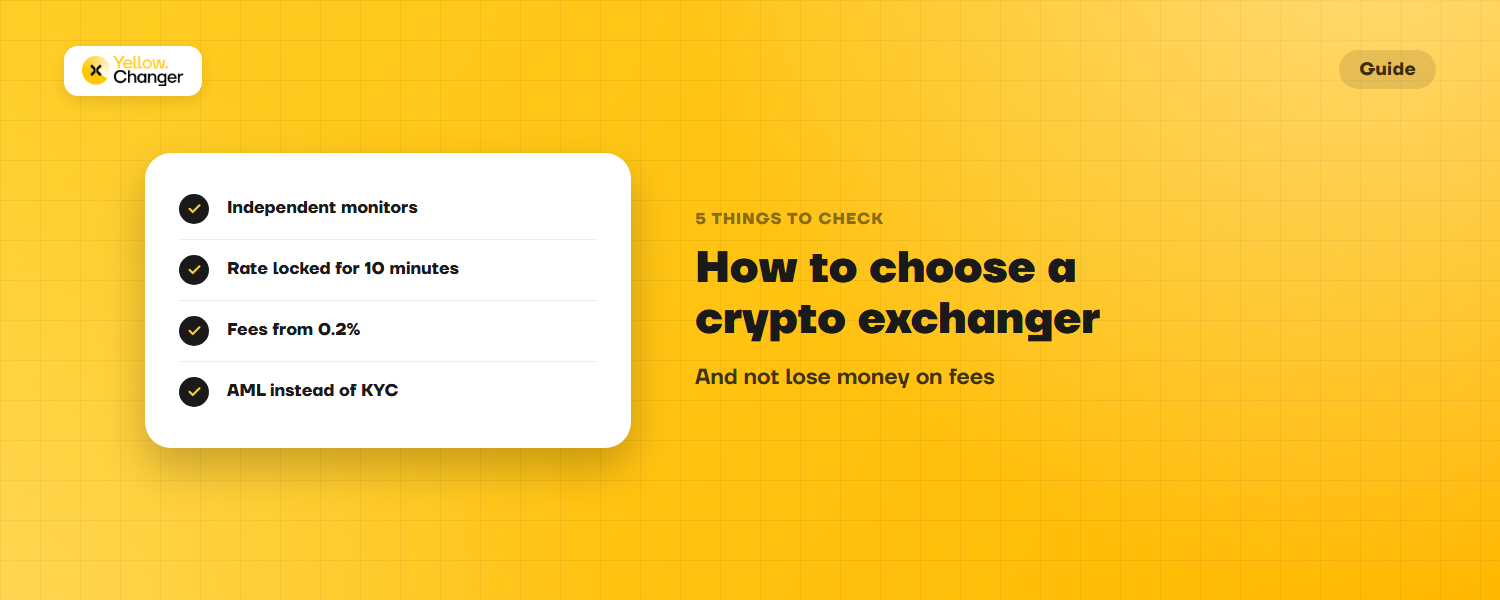
A trustworthy crypto exchanger gets checked before you send a deposit. Five things are worth looking at: its standing on independent monitors, whether the rate is locked when you create a request, what verification actually requires, how the final fee is put together, and whether the service has clear rules and a live reserve.
#Check independent monitors, not just the service's own site
An exchanger's own website can't be the only source — by definition, it'll only show good reviews. Dedicated monitors like BestChange aggregate dozens of exchangers and surface each one's history of issues, while independent platforms — Trustpilot, Wellcrypto, Bits.media — publish reviews the service itself can't delete.
An exchanger that's avoided registering on independent monitors for years isn't proof of a problem by itself, but it's a reason to look more closely at everything else.
#Check whether the rate is locked at request time
The rate on the landing page looks equally attractive on almost every exchanger — the difference shows up at payment. On some services the rate is fixed: the amount you see when creating the request is the amount you get, provided the deposit lands inside the given window. On others it floats and is recalculated when the deposit credits, usually for a lower fee. Neither is better: a fixed rate matters when you need an exact figure, a floating one pays off when you can absorb market movement during the transfer.
#Ask what verification actually requires
Some exchangers require full KYC — a passport, a selfie, sometimes proof of the source of funds. Others operate without identity verification and instead check the sending address under an AML policy: the address gets a risk score, and at an ordinary risk level the request goes through automatically. Ask upfront which of the two approaches a service uses, and what happens when the check does trigger. It decides both how long your first exchange takes and whether you can get your money back without paperwork.
#Compare the actual fee, not just the rate on the landing page
On many services the fee depends on the exchange mode and your trading volume rather than being a fixed number — and the landing page won't show that. Check it at the confirmation step, once the service displays the final amount you'll receive. Comparing exchangers by the rate on their storefront is pointless: two platforms showing the same rate can end up a percent and a half apart once each has taken its cut.
#Read the rules and check the reserve before you send
The reserve is how much the service can actually pay out in your direction right now. If it's smaller than your request, the exchange either stalls or gets split into parts. Monitors and the exchangers themselves both publish reserves, but you need to check at the moment of the trade, not against yesterday's screenshot. The other half of this point is the rules. A serious service has a dedicated page covering refund terms, its AML policy, and what happens if a request is paused. No such page, or one written in generalities, leaves you nothing to argue with when something goes wrong. YellowChanger, for one, publishes its rules and AML policy on a separate page, and the final amount you'll receive is visible before you confirm — on the USDT (TRC20) → rubles via SBP page, for example.
#FAQ
#Do crypto exchangers require KYC?
It depends on the service. Some platforms require full identity verification before your first trade; others skip it and check the sending address under an AML policy instead of asking for a passport. There's no market-wide rule, so it's worth clarifying before you send a deposit rather than after.
#How do I check an exchanger's reliability before my first exchange?
Through independent monitors like BestChange and review platforms like Trustpilot, Wellcrypto, and Bits.media — not just the reviews on the service's own site.
#What's the difference between a fixed and a floating rate?
A fixed rate locks the amount you'll receive for a limited time from when the request is created (10 minutes, for example); a floating rate recalculates once the deposit actually lands, usually in exchange for a lower fee.
#Why does the fee for the same pair differ between exchangers?
Because there is no comparable baseline. Each exchanger builds its own spread over the market rate into the price, plus the network fee for the payout, the cost of holding a reserve in that currency, and its own margin. On some services the rate also depends on the rate mode and the customer's volume. That's why two platforms advertising the same rate hand you different amounts.